


























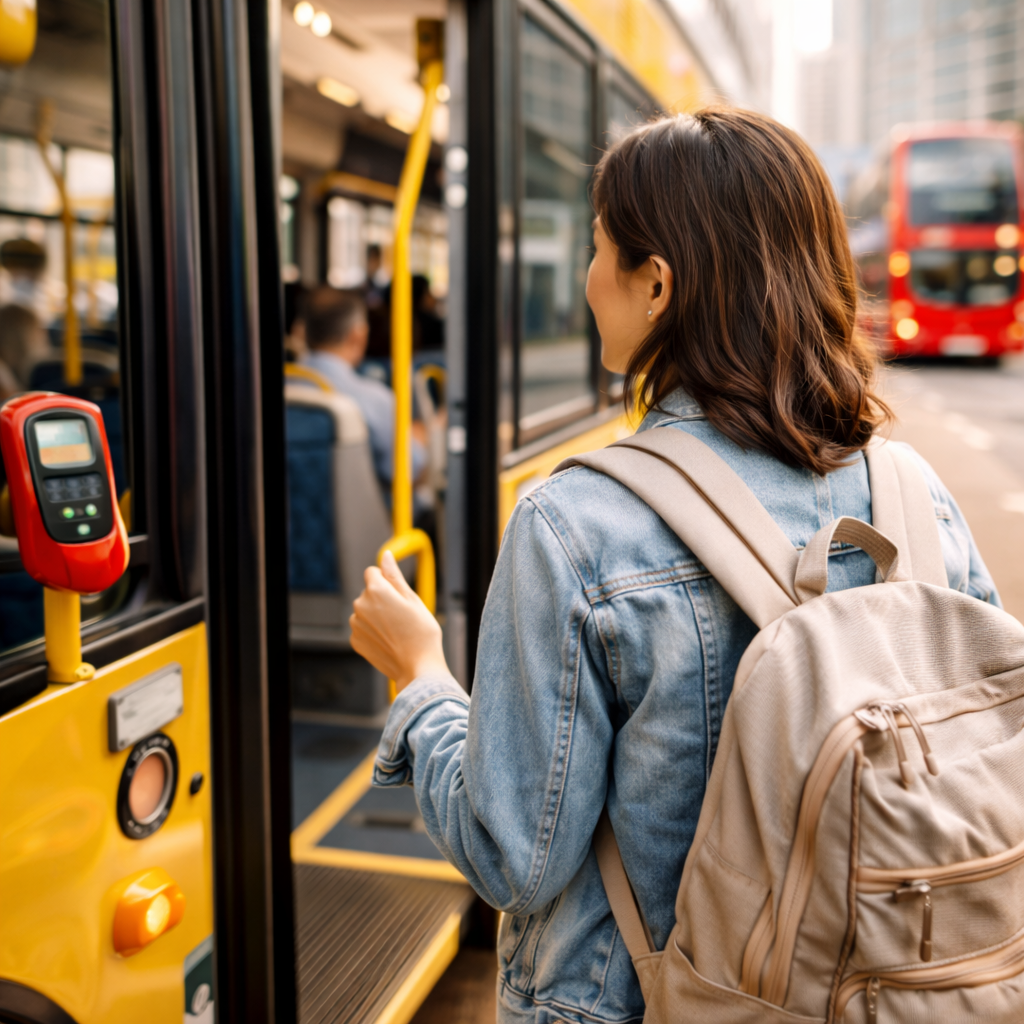
Every day, millions of people travel from one place to another. They use buses, trains, cars, and bicycles. Transportation is a vital part of daily life. In this lesson, you will discover the most common vehicles in English. Simple words. Big impact.
Definition
Transportation means moving from one place to another. A vehicle is any machine that carries people or things. Buses, cars, trains, and bikes are all vehicles. We use them every single day.
At the A1 level, learning basic transportation words is a key first step. You will learn names like taxi, plane, and subway. These are essential words for real conversations. Short words. Powerful meaning.
Why Should You Learn This?
Transportation vocabulary is everywhere. You need it at the airport, on the street, and at the bus stop. When you travel to an English-speaking country, these words help you ask for directions and buy tickets. They are practical and immediately useful. Learn them now, use them tomorrow. It is that simple.
Key Points
- Common Vehicles: The most important words are bus, car, train, bike, taxi, and plane.
- The Verb "Take": We say take the bus or take the train — this is the standard phrase in English.
- The Verb "Ride": For bikes and motorcycles, we use ride — for example, I ride my bike.
- The Verb "Drive": For cars, we use drive — for example, She drives a car. Simple and clear.
- Public vs. Private: A bus or subway is public transport. A car or taxi is more private.
- At the Stop: Key phrases include bus stop, train station, and airport — critical places to know.
- Simple Questions: You can ask, How do you go to school? and answer, I take the bus — a foundational conversation pattern.
Example Sentences
- I take the bus to school every morning.
- She rides her bike to the park on Sundays.
- They drive a car to the supermarket.
- He takes the train from London to Manchester.
- We are at the bus stop. The bus comes in five minutes.
- My father takes a taxi when it rains.
- The children go to school on foot. They walk every day.
- Her family travels by plane to visit grandma.
- The subway is fast. I use it in the city.
- How do you get to work? — I take the train.
Usage Areas
Transportation words appear in almost every real-life situation. Whether you are at an airport, standing on a street corner, or simply chatting with a friend, these terms come up again and again. Knowing them opens doors. Literally.
Asking and Answering About Daily Travel
One of the most common situations is describing how you get somewhere. You might hear: How do you go to school? The natural response is: I take the bus or I ride my bike. Short, clear, and immediately understood. Use take with buses, trains, taxis, and planes. Use ride with bikes and motorcycles. Use drive when you are the person behind the wheel.
At Locations and Stops
Knowing place names is just as important as knowing vehicle names. At a bus stop, you wait for the bus. At a train station, you board the train. At an airport, you catch a plane. These location words go hand in hand with vehicle vocabulary. Say them together: I am at the train station. Simple. Powerful.
Public vs. Private Options
Not all vehicles work the same way. A bus or subway is shared with many people — this is public transport. A car or taxi is more personal. Understanding this difference helps you choose the right word in any conversation. Context matters. Always.
Step-by-Step Learning Guide
- Step 1: Start with the six core vehicle words: bus, car, train, bike, taxi, and plane. Say each word out loud three times. Repeat until they feel natural on your tongue.
- Step 2: Match each vehicle with its correct verb. Write these pairs: take the bus, take the train, drive a car, ride a bike. These combinations are the building blocks of real sentences.
- Step 3: Build your first sentence. Choose a vehicle and say where you go with it. For example: I take the bus to school. One subject, one verb, one destination. That is all you need.
- Step 4: Learn the location words that go with vehicles. Connect bus with bus stop, train with train station, and plane with airport. Pairs are easier to remember than single words.
- Step 5: Practice the question-and-answer pattern: How do you go to...? — I take the... Ask a friend, ask yourself in a mirror, or write it down. Repetition builds confidence.
- Step 6: Look around you. When you see a vehicle in real life or in a picture, name it in English immediately. Connect the word to a real image. Your brain will hold on to it much longer.
- Step 7: Review all six vehicles and their verbs one final time. Then create two new sentences of your own — no examples, no help. Original output proves real understanding. You have got this.
Summary
In this lesson, you explored the most common vehicles used in everyday life — bus, car, train, bike, taxi, and plane. You discovered that the verb you choose depends on the vehicle: take for buses and trains, drive for cars, and ride for bikes. You also connected vehicles with key locations such as bus stop, train station, and airport. Finally, you practiced the core question pattern — How do you get to...? — and learned how to answer it with confidence. These building blocks are now yours to use in real conversations, every single day.
Vehicle and Verb Chart
| Vehicle | Correct Verb | Example Sentence | Type |
|---|---|---|---|
| Bus | take | I take the bus to work. | Public |
| Train | take | She takes the train every morning. | Public |
| Subway | take | He takes the subway in the city. | Public |
| Taxi | take | We take a taxi when it rains. | Private |
| Plane | take / travel by | They take a plane to visit family. | Public |
| Car | drive | My mother drives a car to the office. | Private |
| Bike | ride | I ride my bike to the park. | Private |
| Motorcycle | ride | He rides a motorcycle to school. | Private |
Tips and Tricks
- Group by verb: Write three columns — take, drive, ride — and place each vehicle under the right verb. Visual grouping makes the pattern stick faster.
- Use what you see: Every time you spot a vehicle outside — a passing bus, a parked car, a cyclist — say its English name and verb aloud. Real-world repetition is more powerful than any textbook.
- Pair words with places: Always link a vehicle to its location. Think bus — bus stop, train — train station, plane — airport. Paired memory is stronger memory.
- Practice one question daily: Ask yourself each morning: How do I get to...? and answer in English. One question, one answer — thirty seconds a day builds lasting fluency.
- Public or private? When you hear a new vehicle word, immediately ask: is it public or private? This simple habit sharpens your understanding of context and word choice.
Common Mistakes
Incorrect: I ride the bus to school.
Correct: I take the bus to school.
Explanation: We use ride only with bikes and motorcycles. For buses, trains, and taxis, always use take.
Incorrect: She drives her bike to the park.
Correct: She rides her bike to the park.
Explanation: The verb drive is only for cars and trucks. For bicycles and motorcycles, the correct verb is ride.
Incorrect: I go to school by the bus.
Correct: I go to school by bus.
Explanation: When using by with a vehicle, do not add the article the. Say by bus, by train, by car — no article needed.
Incorrect: He takes a foot to school.
Correct: He goes to school on foot.
Explanation: Walking is expressed with the fixed phrase on foot. It is not a vehicle, so we never use take with it.
Conclusion
You have now covered the core of basic transportation in English — the vehicles, the verbs, the locations, and the patterns that connect them all. These are not just words on a page; they are tools you can reach for the moment you step outside. Every bus you see, every trip you plan, every conversation about getting somewhere becomes an opportunity to use what you have learned here. The path from knowing a word to owning it is simply practice — consistent, curious, and confident practice. Keep going. You are already moving in the right direction.